Keyboard Shortcuts
Every binding below is the default and every one can be changed: Ctrl+, opens the key map. Ctrl+K opens the command palette, which finds any command by name without needing a key at all.
On macOS, read Ctrl as Cmd.
Transport
| Shortcut | Command |
|---|---|
Space | Play / pause |
Ctrl+Home | Back to the start |
↑ | Jump back a few words |
↓ | Jump forward a few words |
Ctrl+Shift+F | Freeze |
Pace
| Shortcut | Command |
|---|---|
→ | Faster |
← | Slower |
Ctrl+Alt+1 2 3 | The three pace presets |
The mouse wheel changes the pace anywhere in the app.
Markers and chapters
| Shortcut | Command |
|---|---|
Ctrl+M | Drop a marker here |
Ctrl+↓ | Next marker |
Ctrl+↑ | Previous marker |
Ctrl+Shift+↓ | Next chapter |
Ctrl+Shift+↑ | Previous chapter |
Chapter and marker jumps stop at the ends. At the last chapter, "next" does nothing rather than wrapping round to the first — a jump to the top of the script in the middle of a program is never what anyone meant.
Appearance
| Shortcut | Command |
|---|---|
Ctrl+= | Larger type |
Ctrl+- | Smaller type |
Ctrl+Shift+= | Wider margin |
Ctrl+Shift+- | Narrower margin |
Alt+= | More words per line |
Alt+- | Fewer words per line |
Ctrl+I | Invert colors |
These are the presenter's screen, not the editor.
Output
| Shortcut | Command |
|---|---|
Ctrl+Enter | Broadcast on / off |
Ctrl+B | Blackout |
Ctrl+Alt+M | Mirror |
Ctrl+Alt+R | Rotate |
Ctrl+Shift+1 … 9 | Put card 1–9 on screen |
Ctrl+Shift+0 | Clear the screen |
Script and project
| Shortcut | Command |
|---|---|
Ctrl+S | Save the project |
Ctrl+Shift+Alt+S | Save the project as… |
Ctrl+O | Open a project |
Ctrl+N | New project |
Ctrl+Shift+S | Export the script |
Ctrl+Alt+S | Export the script as… |
Ctrl+Shift+C | Insert a chapter mark |
Ctrl+Shift+D | Wrap as a stage direction |
Ctrl+F | Find, replace and paint in the script |
Ctrl+Shift+L | Strip formatting |
Ctrl+Z | Undo |
Ctrl+Shift+Z | Redo |
Ctrl+T | New tab |
Ctrl+W | Close tab |
Ctrl+D | Duplicate the active tab |
View
| Shortcut | Command |
|---|---|
F1 | Split |
F2 | Focus |
F3 | Desk |
F5 | Assets column |
F6 | Cards drawer |
F7 | Settings |
F8 | Transport at the top / in the footer |
F11 | Toggle focus mode |
Ctrl+Alt+= | Interface larger |
Ctrl+Alt+- | Interface smaller |
Ctrl+Alt+0 | Interface back to 100% |
Ctrl+K | Command palette |
Ctrl+, | Key map |
Ctrl+Shift+K | Map shortcuts on screen |
Ctrl+Shift+P | Change the theme |
Mapping by pointing at the button
Ctrl+Shift+K turns on mapping mode. The app paints a lit rectangle over every control that accepts a shortcut, with its current key printed inside. Click the one you mean, press the key, done.
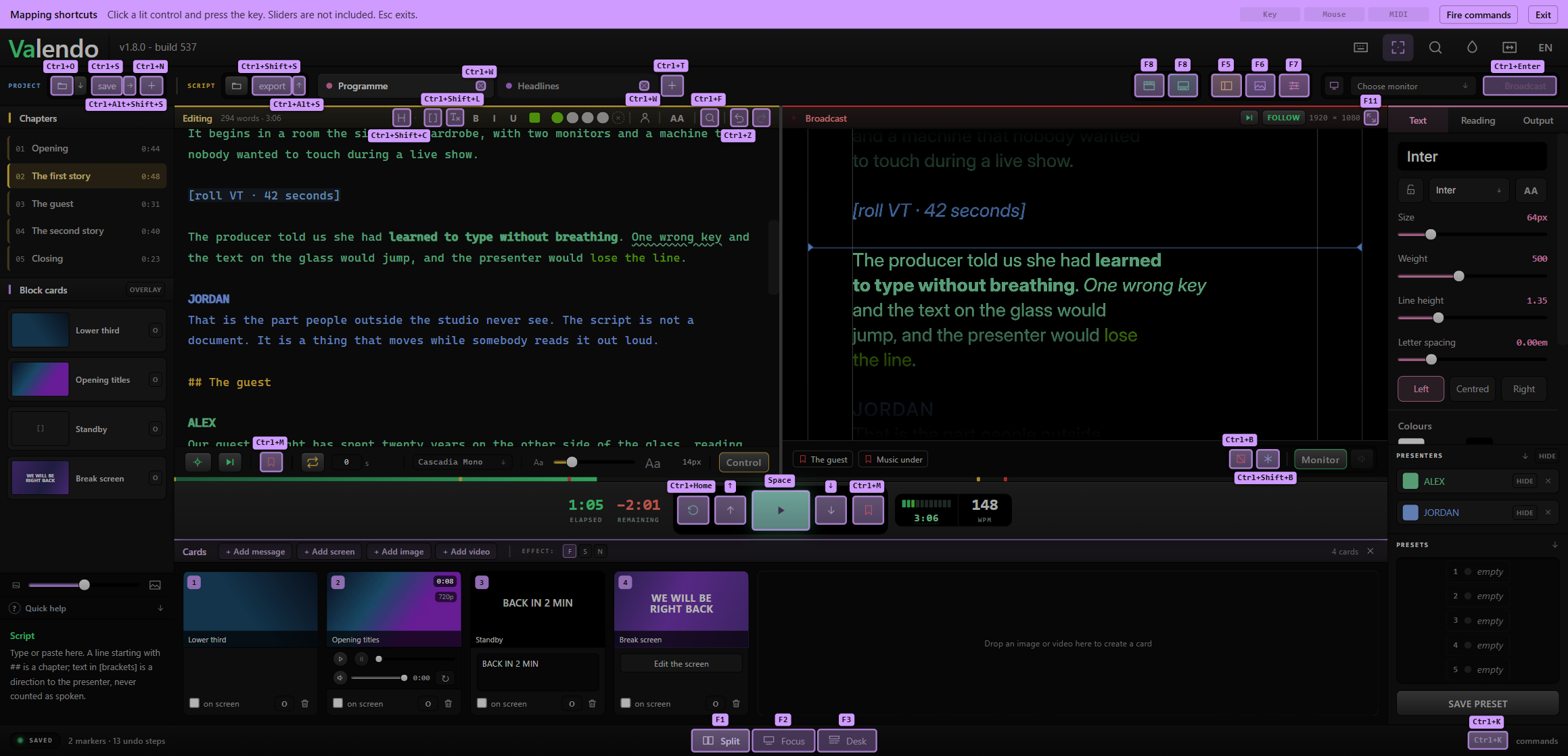
That is the answer to the question the list above cannot give: what is this button's key? You are looking at the button, not scrolling ninety command names hoping to recognize one.
Three things worth knowing before you turn it on:
- The layer swallows clicks, including the play key. A band across the top stays visible the whole time saying so and how to leave.
Escexits from anywhere, and the header key stays lit while the mode is on. - Sliders are not included. Pace, type size, margin, volume — nothing continuous is mappable: a key can only step a slider, and a step is not what those controls are for.
- It works with the show on air. Blocking it there would be deciding for you, and mapping a pad during a rehearsal is a legitimate thing to want.
A MIDI controller
The same mode accepts a pad instead of a key: click a lit rectangle and press the button on the surface. The binding is stored beside the keyboard one, so a command can have both.
The full list has three columns — keyboard, mouse and control surface — and the search finds a command by any of them.
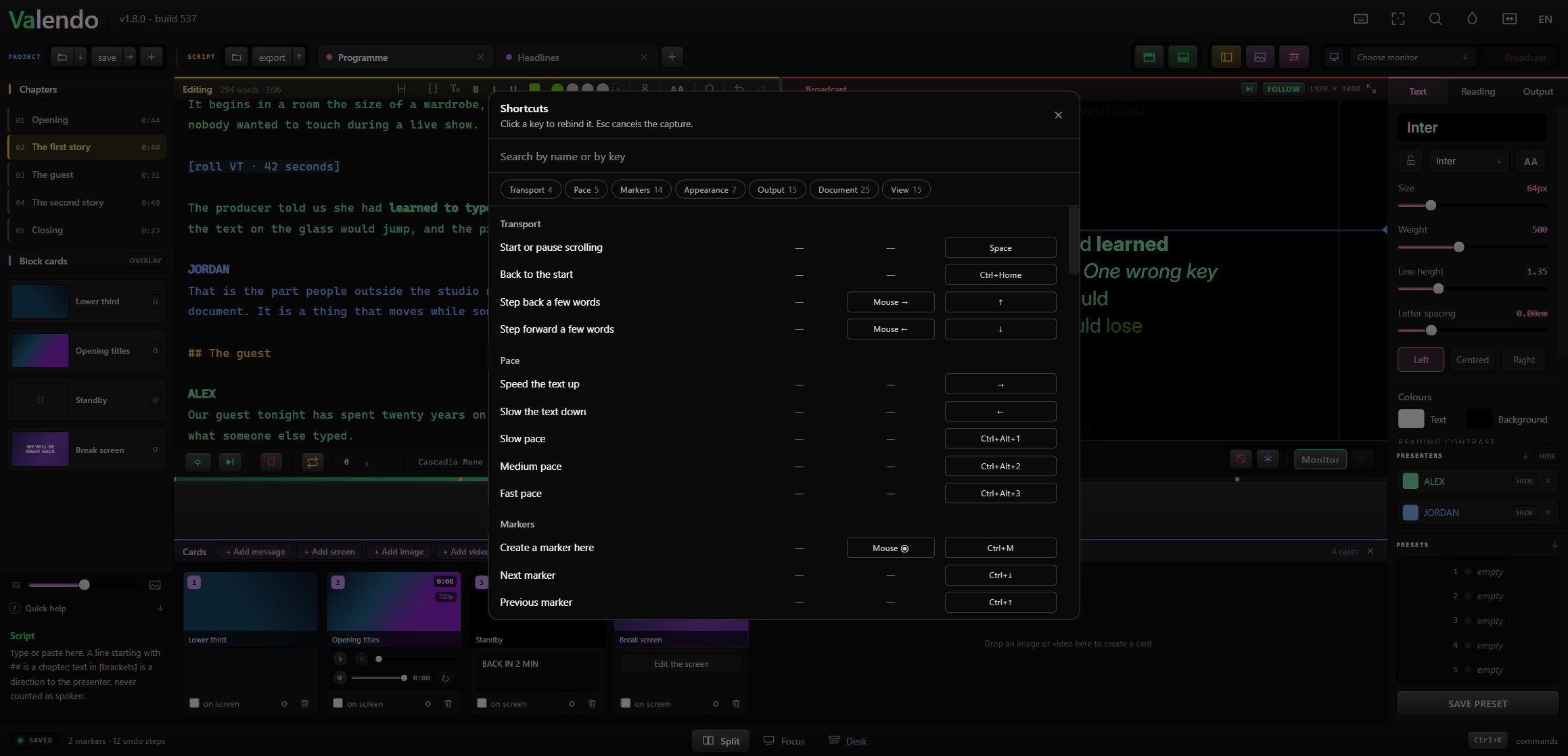
Only note-style messages are read, which is to say pads and buttons, not faders or knobs — the same reason sliders are out. Permission is asked once, and only the operator window ever listens.
Two families that never share a key
F1 F2 F3 are the three modes — whole screens, mutually exclusive. F5 F6 F7 F8 are the panels, which toggle on top of whatever mode you are in. They are kept apart: a key that sometimes replaces the screen and sometimes toggles a panel would be a key you cannot press without looking.